The Memo - 14/Aug/2026
To: US Govt, major govts, Microsoft, Apple, NVIDIA, Alphabet, Amazon, Meta, Tesla, Citi, Tencent, IBM, & 10,000+ more recipients… From: Dr Alan D. Thompson Sent: 14/Aug/2026 Subject: The Memo - AI that matters, as it happens, in plain English AGI: 97 ➜ 98% ASI: 2/50Mark…
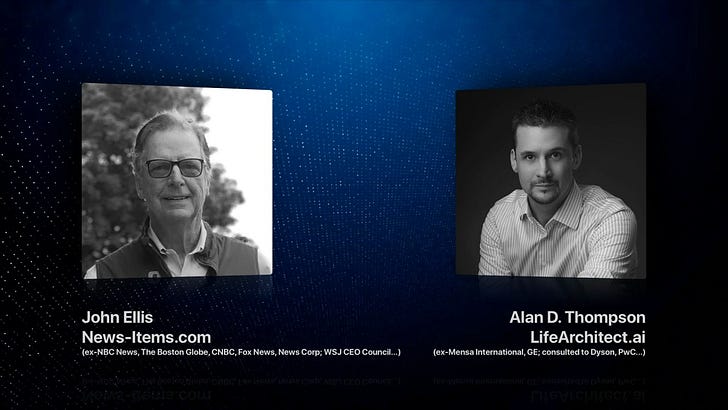
To: US Govt, major govts, Microsoft, Apple, NVIDIA, Alphabet, Amazon, Meta, Tesla, Citi, Tencent, IBM, & 10,000+ more recipients… From: Dr Alan D. Thompson Sent: 14/Aug/2026 Subject: The Memo - AI that matters, as it happens, in plain English AGI: 97 ➜ 98% ASI: 2/50Mark Zuckerberg, Meta CEO (10/Aug/2026):’Invention, not automation, will be the greatest contribution of superintelligence… it will increasingly help discover new knowledge—ranging from discovering new drugs to cure a family member's disease to finding new ways to improve your business… the number of valuable things superintelligence can invent to help achieve your goals is unlimited… Everyone will soon have invention superpowers... I am optimistic that the coming decades will be some of the most amazing in history.’I’ve done a lot of media interviews. Some journalists do very little prep (and it shows) while others treat the research phase as a full-time job (Dwarkesh Patel famously spends two weeks reading, researching, and synthesizing information about his guest before he interviews them). This month I was lucky enough to be in the hot seat with John Ellis, one of those rare interviewers whose preparation is matched by an extraordinarily deep reservoir of experience. At the end of this edition, I detail how I prepare for big media interviews.John is the founder and editor of News Items, having spent his entire adult life in journalism, as a political analyst at NBC News, a columnist at The Boston Globe, and in roles at CNBC, Fox News, Newscorp, and the WSJ. He brings Fellowships from Harvard and West Point, and is of course a longtime subscriber of The Memo. He knew which threads were worth pulling, and which questions would get my ‘behind-the-scenes’ answers. Listen on Spotify, Apple, Audible, iHeart, Substack, and YouTube:FT reports (7/Aug/2026) that ByteDance is training a Mythos-scale, 10-trillion parameter model (though FT messed up some of the other estimates), and I’ve updated the latest viz accordingly.https://lifearchitect.ai/models-table/?tab=vizContentsThe BIG Stuff (Gemini Robotics 2, Claude + Riemann hypothesis, OpenAI exodus…)The Interesting Stuff (DeepMind leadership, China, Terafab, DC shipping containers…)Policy (AI watermarking, HF incident, K3, US voluntary framework, 2GW in Armenia…)Toys to Play With (Claudecraft, houseplants + AI, Claude 3× verbosity, AI-native dev…)Things I’ve Been Thinking About (Crystal ball, media prep…)Next (Roundtable…)The BIG StuffGoogle DeepMind Gemini Robotics 2 achieves whole-body humanoid control (30/Jul/2026)Source: Google.A three-model architecture spanning vision-language-action, embodied reasoning, and on-device adaptation now controls entire humanoid robots ‘from feet to fingertips,’ with Apptronik Apollo 2 performing tasks like knot-tying and ziplock sealing, while On-Device 2 adapts to new bi-arm embodiments from fewer than 200 examples in just hours. ER 2 acts as a high-level agentic brain, running task sequences lasting several minutes across hundreds of decisions, self-correcting on failure, and coordinating multiple robots on workflows no single robot could complete alone. DeepMind frames this directly as ‘an important milestone on the path toward solving AGI in the physical world.’The AGI countdown was revised to 98% based on this achievement.Read more via Google DeepMind blog, and see also: safety report (PDF), developer blog, announce video, whole-body video, dexterity video, and the three models on the Models Table.Claude and the Riemann hypothesis (10/Aug/2026)Anthropic: We asked an unreleased research version of Claude to take a stab at the Riemann hypothesis (wiki).It didn’t solve it, but it did make strides on a related problem: it increased the lower bound for the fraction of zeros of the Riemann zeta function that satisfy the hypothesis from 41.6% to 67.2%. (Twitter)An unreleased research version of Claude improved a longstanding lower bound for the fraction of zeros of the Riemann zeta function satisfying the Riemann hypothesis, raising it from 41.6% to 67.2%. The result emerged as an unintended byproduct of a non-mathematician staff member prompting Claude to ‘take a real stab’ at the full hypothesis itself, with the model coordinating roughly 60 subagents over 31M output tokens, while the human’s input was mostly limited to variants of ‘keep going’ and ‘believe in yourself.’ Claude produced both a traditional paper and a formally verified Lean proof, and two Anthropic mathematicians validated the work alongside external experts Brian Conrey and Dan Goldston.Sidenote: My ASI checklist no longer tracks mathematics indicators, as I consider it to be a solved problem. Readers can view alternative AI math tracking at VibeMathed.com.Read more: https://www.anthropic.com/research/riemann-zetaExclusive: OpenAI staff head for the lifeboats (11/Aug/2026)Brad Lightcap, OpenAI’s longest-serving operations executive (joined 2018, served as CFO then COO), is leaving to build something focused on ‘a few important new things the world will need to get right’ as AI grows more powerful. Lightcap’s mind has begun to wander to matters outside of OpenAI in the past few months, he said. He’s been “focused on the next horizon,” and solving issues he says might “stand in the way” of achieving OpenAI’s vision of creating AGI, or artificial general intelligence, a still theoretical concept of AI that can match or surpass humans at most tasks. He did not elaborate, though it could relate to politics, infrastructure, public adoption, or any of the myriad challenges AI faces as the technology integrates into many aspects of society.His departure is the most significant of a wave of exits as OpenAI plans a US$1T+ IPO. Former employees told Fortune that many staff made around US$10M each from the company’s recent buyout of employee shares, with senior leaders like Lightcap presumably receiving far more.Major OpenAI staff departures in 2026:Brad Lightcap (COO, then special projects lead)Bill Peebles (head of Sora video app)Kevin Weil (VP of OpenAI for Science)Srinivas Narayanan (CTO of B2B applications)Barret Zoph (head of enterprise sales)Fidji Simo (CEO of Applications)Johannes Heidecke (head of safety)Chloé Bakalar (head of ethics)Read more about Brad’s departure via Fortune and Reddit thread.Read more about Chloé’s departure via FT.The Memo features in recent AI papers by Microsoft and Apple, has been discussed on Joe Rogan’s podcast, and a trusted source says it is used by top brass at the White House. Across over 100 editions, The Memo continues to be the #1 AI advisory, informing 10,000+ full subscribers including RAND, Google, and Meta AI. Full subscribers have complete access to all 25+ AI analysis items in this edition!The Interesting StuffAI computing power becomes a tradable asset class as CME launches futures contracts (11/Aug/2026) Read moreSource: Life Architect AI — Published — Category: Models
⚡ Popular — 52 views