To: US Govt, major govts, Microsoft, Apple, NVIDIA, Alphabet, Amazon, Meta, Tesla, Citi, Tencent, IBM, & 10,000+ more recipients… From: Dr Alan D. Thompson Sent: 16/Oct/2026 Subject: The Memo - AI that matters, as it happens, in plain English AGI: 99% ASI: 2/50My submission to…
Annons
Annons
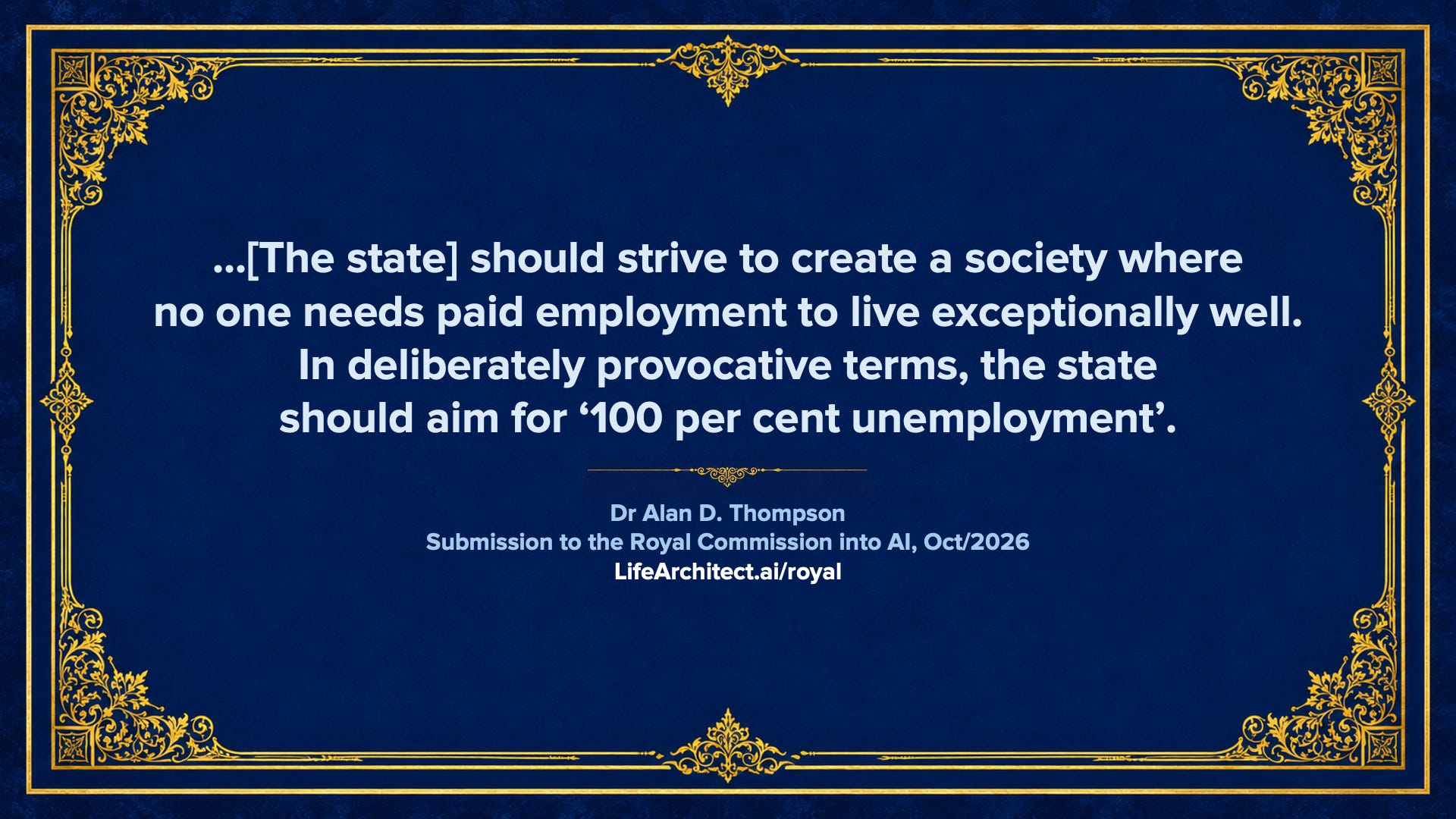
To: US Govt, major govts, Microsoft, Apple, NVIDIA, Alphabet, Amazon, Meta, Tesla, Citi, Tencent, IBM, & 10,000+ more recipients… From: Dr Alan D. Thompson Sent: 16/Oct/2026 Subject: The Memo - AI that matters, as it happens, in plain English AGI: 99% ASI: 2/50My submission to Australia’s first Royal Commission on AI has been well received. I wasn’t going to make the electronic submission into a paperback, but I’m glad I did. It hit #3 on one Amazon bestseller category and #10 in the generative AI category. You can order a copy here.I plan to include a quote from the 67-page report in each edition of The Memo until the end of the year. Here’s the first one!https://lifearchitect.ai/royal/I won’t be turning this into an animated edition, but the comic below is a great summary of how professional mathematicians reacted to OpenAI’s release of 719 new maths papers produced by its private, internal model (7/Oct/2026). Source: Reddit.Frankly, I’m bored of this lazy, fearful, default response. I expected more from the likes of Adelaide-born Prof Terence Tao, whose gatekeeping has been incredibly disappointing to witness (including his repost of the AHM statement 7/Oct/2026, though some early recovery to 16/Oct/2026). I think Ray Kurzweil said it best (2009):It’s taken me a while to get my mental and emotional arms around the dramatic implications of what I see for the future [in AI]. So, when people have never heard of ideas along these lines, and hear about it for the first time and have some superficial reaction, I really see myself some decades ago. I realize it’s a long path to actually get comfortable with where the future is headed.As I announced on the ASI checklist, AI solved maths about five months ago (May/2026). Now let’s move on to the next ‘low-hanging fruit’ fields, including physics, medicine, energy, materials, and much more! ContentsThe BIG Stuff (ASI indicators, Gemini 4 Argon, Neural networks are already clean…)The Interesting Stuff (Muse Wonder Full, AI TLDs, agentic bank runs, …)Policy (World Bank urges crisis-era, OpenAI bugging, self-replication, macOS disk…)Toys to Play With (AI nightclub, SynthID for public, Muse hardware, Warcraft…)Things I’ve Been Thinking About (Long reports…)Next (Roundtable…)The BIG StuffASI indicators for the first half of October 2026 (16/Oct/2026)This is an incredibly exciting time to be alive. I think October 2026 through to March 2027 will be viewed as the six-month envelope that delivered a complete evolution for humanity. (And of course, we’ll continue covering it all right here in The Memo.) None of the following 11 indicators made the evening news or the front page. All are tracked on ‘Alan’s ASI indicators’: https://lifearchitect.ai/asi/Google DeepMind’s Gemini 4 found new exact solutions for holding plasma inside asymmetrical stellarator fusion reactors. (paper)Anthropic replaced git with Scion, an in-house version control system built largely by Claude, after daily code merges grew 12x in four months. (announce)Sakana AI and UC Berkeley’s MASS lets Qwen3.6-27B act as its own solver, optimizer and judge, then fine-tune itself on its best runs, getting better with no stronger supervisor. (announce, paper, code)A citizen scientist using Claude Code found a never-reported rocky planet 1.4x Earth’s size orbiting a star 116 light-years away, with dip times published ahead of NASA TESS re-observation. (announce, preprint, predictions)Claude Opus 5.5 agents at Vals AI designed one new magnet and surfaced another overlooked since 1999 as candidates for next-gen computer memory. (announce, GitHub)Google DeepMind released AlphaProtein Novo, which designs brand new enzymes from scratch for reactions that don’t exist in nature, including ones that break down a plastic pollutant. (announce, GitHub)Tianjin University unveiled a 3-gram ‘Brain Cube’ that hides in the user’s hair, billed as the smallest non-invasive brain-computer interface yet. (Science and Technology Daily)Singapore opened a S$100M Home Team Humanoid Robotics Centre, aiming to put humanoids alongside police, civil defence and prison officers by 2028. (article, MHA speech, see the Policy section in this edition)Harvard’s Prof Matthew Schwartz used Claude Fable 5 to produce 36 manuscripts across 18 scientific fields in three months, including 15 never-before-computed Feynman integrals. (announce, GitHub, NBER paper)MIT’s Prof Markus Buehler reports Claude Fable 5.1 built its own atomistic simulation tool from scratch, then spent days autonomously finding design rules for tougher graphene, with some designs ~25% stronger. (announce, article, GitHub, dataset)Prof Matt Landreman used GPT-6 Astra to find two new families of exact 3D plasma equilibria, overturning Harold Grad’s 1967 conjecture and firming up the theory behind stellarator fusion reactors. (paper, code, Gómez-Serrano et al paper)A star 116 light-years out, with two planet candidates nobody had noticed. Found in seven years of public NASA data using Claude Code. Source: Reddit.The Memo features in recent AI papers by Microsoft and Apple, has been discussed on Joe Rogan’s podcast, and a trusted source says it is used by top brass at the White House. Across over 100 editions, The Memo continues to be the #1 AI advisory, informing 10,000+ full subscribers including RAND, Google, and Meta AI. Full subscribers have complete access to all 25+ AI analysis items in this edition!Gemini 4 Argon + Robotics (13/Oct/2026) Read more