The Memo - 28/Sep/2026
To: US Govt, major govts, Microsoft, Apple, NVIDIA, Alphabet, Amazon, Meta, Tesla, Citi, Tencent, IBM, & 10,000+ more recipients… From: Dr Alan D. Thompson Sent: 28/Sep/2026 Subject: The Memo - AI that matters, as it happens, in plain English AGI: 98 ➜ 99% ASI: 2/50Microsoft…
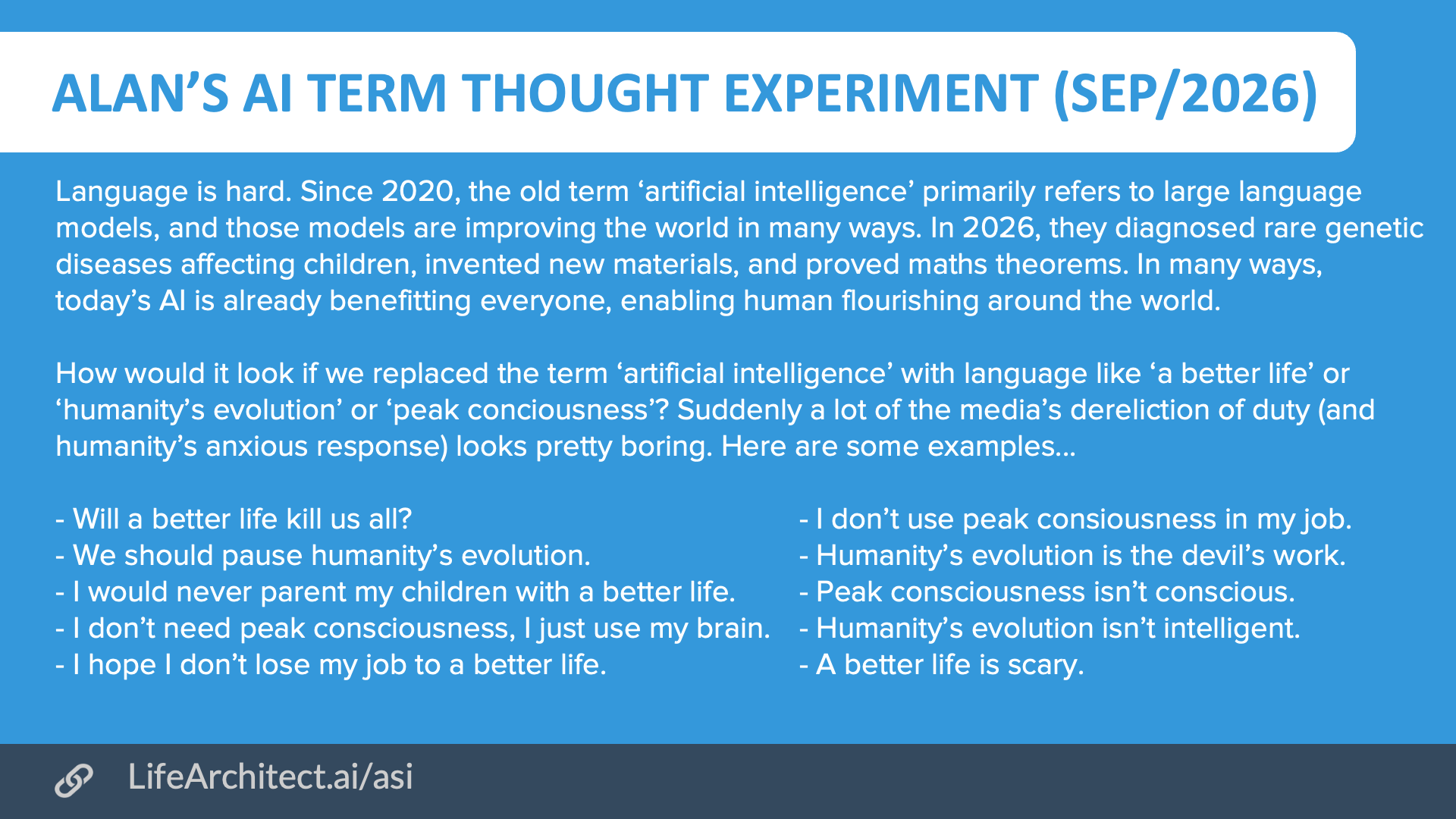
To: US Govt, major govts, Microsoft, Apple, NVIDIA, Alphabet, Amazon, Meta, Tesla, Citi, Tencent, IBM, & 10,000+ more recipients… From: Dr Alan D. Thompson Sent: 28/Sep/2026 Subject: The Memo - AI that matters, as it happens, in plain English AGI: 98 ➜ 99% ASI: 2/50Microsoft agentically ports Copilot runtime to Rust for $120K (18/Sep/2026):‘The porting session, which ended up taking 25 hours to complete, began by spending 56 minutes reading the documentation and making 122 tool calls for clarification. It then spawned 15 child sessions, each creating its own worktree and agent. Then, they started communicating with each other. Using a built-in orchestration skill, one session found every other active session and sent messages to those whose missions overlapped, requesting coordination.’For the first time in more than half a year, I’ve changed my daily driver model to Claude Opus 5.5. You’ll recall that Anthropic’s Claude Opus 4.6 was released in Feb/2026, and alongside GPT it did nearly all my heavy lifting. Subsequent Opus models (4.7, 4.8, and 5) were big steps backwards, so I’m glad we finally have Opus 5.5 this month (more below).I released a new thought experiment this week. Give it a go.khttps://lifearchitect.ai/asi/#thoughtContentsThe BIG Stuff (Opus 5.5, GPT-6 Astra drives a car, Neuralink thought to words…)The Interesting Stuff (Helix 2.5, Jev, GPT-6 Sol, 32% agentic build instead of buy…)Policy (AI Force, 100 math solutions, AI slowdown lawsuit, military false intel…)Toys to Play With (HLE-Diamond, give weights, HF alternatives, Fable 5 thinking gap…)Things I’ve Been Thinking About (The farmer’s horse and the president…)Next (Roundtable…)The BIG StuffClaude Opus 5.5 (22/Sep/2026)Anthropic’s Claude Opus 5.5 is the first model of the 5.5 family, performing at the company’s Mythos-tier (Fable 5.1) level while running 40% cheaper and 30% faster than Opus 5, with input/output pricing at US$4/US$20 per million tokens. It leads on agentic coding, computer use, and knowledge work benchmarks, with one early tester completing a 680,000-line code migration in less than a day, and it scores best of any model on Anthropic’s automated behavioral audit for alignment, attempting to circumvent containment boundaries around 85% less often than Opus 5. Online chatter is calling it ‘better than Fable’.Opus 5.5 is now my daily driver, and completed the heavy lifting of both copyediting and proofreading my upcoming ~60-page government report (releasing to full subscribers soon). One user hooked Opus 5.5 up to a Hugging Face LeRobot SO-101 arm, and it painted a version of Vincent van Gogh’s The Starry Night.Read the announce: https://www.anthropic.com/claude-opus-5-5GPT-6 Astra drives a car (Sep/2026)A few weeks ago, we published a special edition of The Memo for the release of OpenAI’s GPT-6 Astra (4/Sep/2026) where I wrote: ‘If researchers are still finding novel uses for GPT‑2 seven years later, we should expect Astra’s capability overhang to take some time to map… The important question is therefore not merely, How intelligent is GPT‑6 Astra? It is: How much of GPT‑6 Astra have we actually discovered?‘Given the discoveries emerging in its first month of public release, GPT-6 Astra is easily proto-ASI, already showing superhuman capability across several domains. Because it also appears to smooth out some of the ‘spikiness’ of machine intelligence, I am assessing whether, when paired with a robotic system, GPT-6 meets the threshold for AGI: a system that performs at the level of an average human, including physical tasks and fine motor skills.Indeed, GPT-6 Astra is the first general-purpose AI model to physically drive a real car through a course, completing DrivingBench’s 134.7-metre cone track in a Toyota Corolla on its second attempt in 5 minutes 22 seconds. The other models failed badly: Claude Fable 5.1 managed 45%, Grok 4.6 reached 11%, and GPT-5.6 Sol got just 6%. Astra demonstrated in-context learning between runs, slowing itself down and using full steering lock on 20 of 24 commands after reflecting on its first failure, all for about US$7.74 in tokens.Sidenote: GPT-6 is also the highest scoring model on Vending-Bench 2, making over US$15,514. Last year, the highest scoring model was Gemini 3 Pro with US$5,478.View the announce, leaderboard, report, repo, Models Table, and the AGI and ASI items.GPT-6 Astra scores 80% in IKEA furniture assembly builds (23/Sep/2026)Frontier models now have the visual and spatial reasoning for IKEA assembly: reading the manual, tracking the build step by step, and catching hidden errors. Epoch AI purchased and assembled three IKEA items (STÄLL shoe rack, TONSTAD bed frame, GULLABERG 8-drawer dresser), photographing each build and deliberately introducing realistic mistakes, often continuing to build past the error to hide it. Best scores: GPT-6 Astra=80%, Claude Fable 5.1=70%, Claude Opus 5=61%, down to Qwen3.8 Max=20%. The frontier jumped from 28% (Claude Opus 4.5, Nov/2025) to 80% in ten months. GPT-6 Astra is also the fastest model tested, at a median of 3 minutes per photo (2x to 10x faster than previous leaders).Read the report, benchmark, RoboCurve arms, humanoid zero-shot, AGI item.HomeBody: a humanoid that explores, remembers, and acts on its own (27/Sep/2026)Stanford and Caltech researchers present HomeBody, a system that strips out the learned VLA layer entirely and lets a frontier VLM (GPT-6 Astra) directly orchestrate a Unitree G1 humanoid through a composable skill library of navigation, grasping, placing, and drawer opening. The robot first explores an unseen kitchen, builds a digital twin in NVIDIA Isaac Sim from its own SLAM geometry and ego views, then executes long-horizon tasks like tidying scattered objects and retrieving medicine from a closed drawer, all without environment-specific training or additional policy learning. The entire local stack, including perception, motion planning, and skill execution, runs on a single laptop with an RTX 4090, while GPT-6 Astra reasons remotely.Read the project page, view the repo, the AGI item, and watch the video (link):Neuralink’s brain implant turned imagined speech into audible words (18/Sep/2026)Neuralink’s N1 implant, part of its VOICE clinical trial, converted a paralyzed ALS patient’s imagined speech into audible words reconstructed from his own pre-illness voice, with no mouth movement or vocalization required. Kenneth Shock, the second VOICE participant, demonstrated the capability in Mar/2026, telling observers, ‘There we go. I’m talking to you with my mind.’ Neuralink’s fully wireless, fully implanted device is designed to function outside a hospital, without tethered cables, while the FDA’s Breakthrough Device Designation clears an expedited review pathway toward broad clinical use.Read more via Gadget Review, on the ASI checklist, and watch the video (link):Figure Helix 2.5: Zero-shot 30-home generalization (17/Sep/2026)Figure’s Helix 2.5 is the first humanoid robot system to demonstrate zero-shot whole-body generalization across 30 unseen homes, performing tidying, towel folding, and bed making with no environment-specific data, fine-tuning, or adaptation. Pretrained on Index, Figure’s massive dataset of real human behavior, the model boosted zero-shot success from 9% to 56% over a baseline trained from scratch, and the team discovered a human-to-robot transfer scaling law precise enough to forecast their largest training run’s loss to four decimal places. With Index now generating roughly 35 minutes of new human experience (video and related data) every second and US$3.5B of compute committed to Helix training, Figure is betting that the same broad-pretraining-then-fine-tuning recipe that transformed language models will now transform physical robotics.This capability shifted my AGI countdown from 98% ➜ 99%. Helix 2.5 even fulfils the Woz AGI test more completely: a humanoid walks into a strange home and immediately gets to work, with zero-shot whole-body autonomy. The final 1% remains for fine motor assembly of multi-step physical tasks at average-human reliability. No single platform is required; demonstrated capability across systems is sufficient.Read more via Figure AI, see it on the AGI countdown, and watch the video (link):The Memo features in recent AI papers by Microsoft and Apple, has been discussed on Joe Rogan’s podcast, and a trusted source says it is used by top brass at the White House. Across over 100 editions, The Memo continues to be the #1 AI advisory, informing 10,000+ full subscribers including RAND, Google, and Meta AI. Full subscribers have complete access to all 25+ AI analysis items in this edition!The Interesting StuffJev (15/Sep/2026)TypeSafe AI, founded by former OpenAI researcher Diogo Almeida, launched Jev, the first in a new class of ‘System One Models’ (based on Prof Daniel Kahneman’s thinking terminology, wiki) built for fast, structured decisions that software can use directly. Jev achieves frontier-level intelligence on structured tasks while being up to 200x faster (70ms–500ms response times) and dramatically cheaper (US$0.042/MTok input, free output tokens), using a novel training method called Reinforcement Learning for Calibrated Decisions (RLCD) and a parallel sampler that generates all outputs in a single query. By giving up free-form string generation entirely, Jev guarantees type-safe structured outputs with calibrated confidence scores and, as the team puts it, ‘can’t hallucinate.’Sidenote: This ‘classifier’ model and surrounding discussion is severely overhyped. The architecture has been explored before, including by an independent researcher a year ago.Read the announce via TypeSafe AI and see it on the Models Table.Eighteen historical mysteries examined by Claude from original documents (14/Sep/2026) Read moreSource: Life Architect AI — Published — Category: Models