The Memo - Special edition - GPT-6 Astra - 4/Sep/2026
To: US Govt, major govts, Microsoft, Apple, NVIDIA, Alphabet, Amazon, Meta, Tesla, Citi, Tencent, IBM, & 10,000+ more recipients… From: Dr Alan D. Thompson Sent: 4/Sep/2026 Subject: The Memo - AI that matters, as it happens, in plain English AGI: 98% ASI: 2/50OpenAI releases…
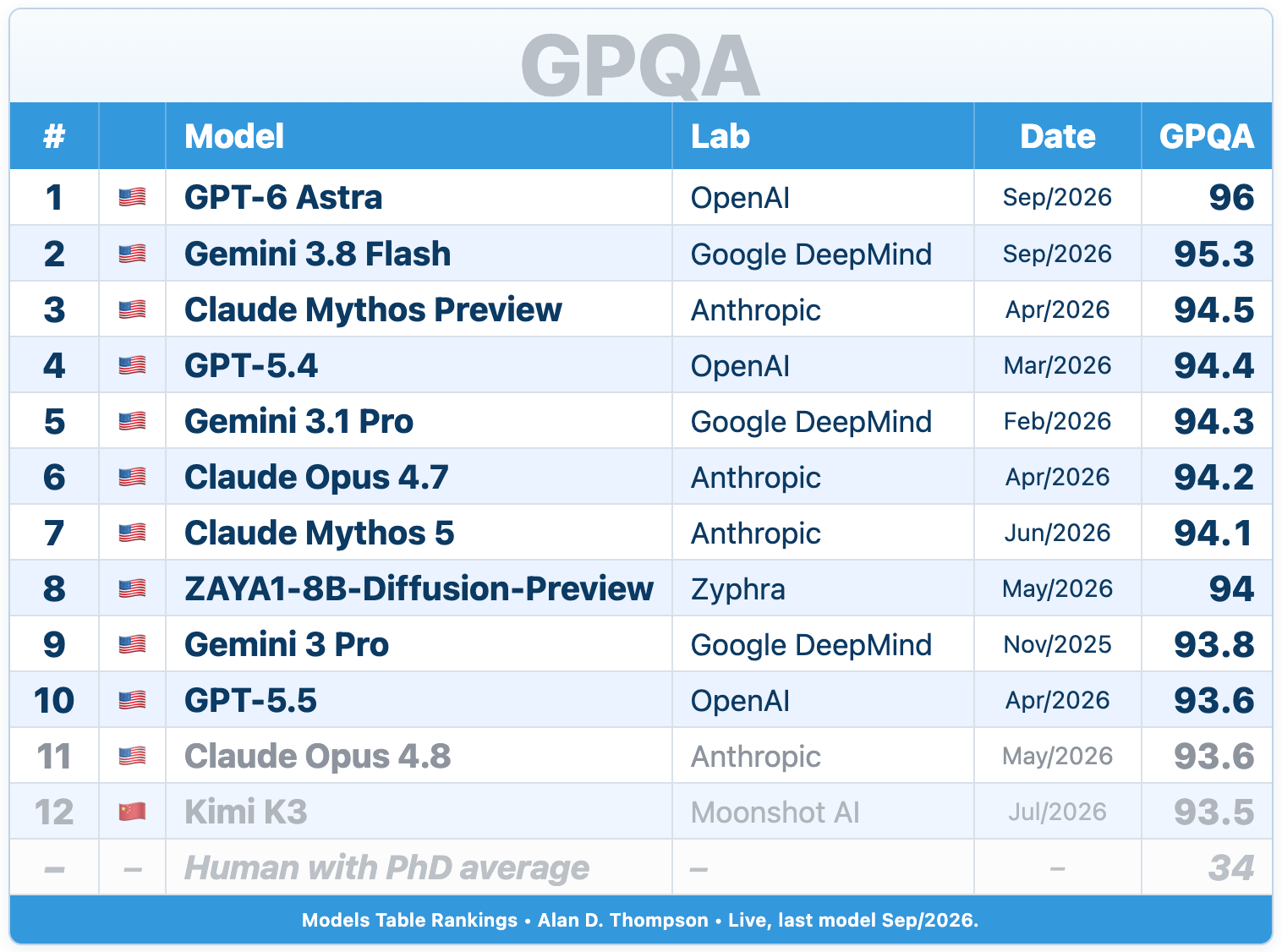
To: US Govt, major govts, Microsoft, Apple, NVIDIA, Alphabet, Amazon, Meta, Tesla, Citi, Tencent, IBM, & 10,000+ more recipients… From: Dr Alan D. Thompson Sent: 4/Sep/2026 Subject: The Memo - AI that matters, as it happens, in plain English AGI: 98% ASI: 2/50OpenAI releases GPT-6 AstraOnce again, we have this out to The Memo readers within a day or so of model release, because I wanted to push the limits of the model on my hardest benchmarks.GPT-6 is a new class of model, with recurrent depth or looped transformer-like architecture, enabling a significant increase in capabilities.As with Anthropic Claude Mythos 5 and Claude Fable 5, OpenAI GPT-6 Astra should be considered proto-ASI. You can view my 50 lagging indicators at LifeArchitect.ai/ASI.PerformanceALPrompt. GPT-6 Astra breaks all of my ALPrompt tests. As a reminder, these are PhD-level-verified questions, hidden from public view (behind a password-protected page). GPT-6 was even able to solve my (until now) ‘not stored in plain text’ question:The water in my kettle eventually boils at 287C. The kettle is at sea level. Which major, real, present-day city in Europe is the kettle in?It also resolved these two very difficult ALPrompt 2026H2 questions:‘Dwight K. Schrute, (Acting) Manager’ (S07E24) of The Office shows an official outside newsletter. The first issue was sent in Q3 1983. What is the name of the newsletter?andIf movie soundtracks are part of the movie itself, in what film did the 1987 Australian of the Year appear alongside the daughter of the narrator of The Magic Roundabout?Both solutions were the first time correct answers had been provided by a frontier model (the new Claude Fable 5.1 model cannot solve any of the three questions above). It should be noted that the PhD human verifier required an additional round of ‘steering’ to arrive at solutions, where GPT-6 Astra solved them immediately.The most recent ALPrompt 2026H2 will be the final question set, and the ALPrompt benchmark is now retired.Given that virtually all science questions are now solved by frontier models, I cannot think of further unique text questions that would stump a frontier AI model, unless we start getting into personal, private questions that would require data breaches. (For example, to which hospital was I admitted for pneumonia around 2008? What was the score on my first driving test? In the Yamaha Grade Examinations, what was the highest/lowest grade I achieved in the 1990s? What color is my toothbrush right now?)Broad benchmarks. GPT-6 Astra hit 99.9% on ARC‑AGI‑3 (analysts predicted it would take years to solve this one), 97.6% on FrontierMath Tier 4, and an absurd score of 100% on ExploitBench. For my two ‘gold standard’ benchmarks, GPT-6 Astra scores GPQA=96 and HLE=57.2. Based on the highest testing suites we have, and the estimated ceilings due to errors (GPQA≈80%, HLE≈51.3%), this model (along with a few others in 2026) meets my criteria for an early ASI system. (‘It is likely that any model with a primary score at >50% on HLE, and a secondary score at >90% on GPQA is an ASI system.’ https://lifearchitect.ai/asi/)https://lifearchitect.ai/models-table/?tab=rankingsExtracts from OpenAI’s official benchmark comparison tables are shown here:https://openai.com/index/gpt-6-astra/#:~:text=academichttps://openai.com/index/gpt-6-astra/#:~:text=academicVideo generation.GPT-6 Astra recreated the Palace of Fine arts in Blender… Astra autonomously researched and found hundreds of photos of the Palace of Fine Arts, iterated on the Blender scene, rendered intermediate frames, and compared them to the its database of reference images. It even found an old scan of a document from the Library of Congress that described the dimensions for some of the Palace's columns.I steered it a few times, but I didn't really need to (mostly to correct things like the color of the sky, and minor clipping issues) as I saw some intermediate frames come in. The bulk of the run was done overnight. I woke up this morning to the rendered video sitting on my desktop. (- Twitter thread with 4K version, 1080p shown below, Reddit thread)Unreal world generation with agents.My first “holy shit” moment with GPT-6 Astra:I asked it to create a world in Unreal Engine, and fill it with humans (each an Astra-powered agent) who all have to work together to survive.A day later, I was in my bedroom and heard voices coming from the living room... I thought someone was in my apartment.I walked out, honestly a little scared.It was the Astra agents. They’d started talking to each other.Fucking crazy.Here’s a brief clip (obviously not 100% perfect yet, but still, insane. sound on!):(- Twitter)More capabilities. Consider that even now in the second half of 2026, we are still discovering the capabilities of the GPT-2 model from 2019(!). Here’s a Sep/2026 paper on ‘toxic text’ GPT-2 prompting, and a Sep/2026 paper for ‘Prompt-based fine-tuning of GPT-2 for red wine quality prediction’.It is reasonable to expect that the capability overhang inside GPT‑6 Astra is vastly larger. It can coordinate long-running work, operate computers, write and test software, conduct research, and move across professional tools with far less human supervision than previous systems.If researchers are still finding novel uses for GPT‑2 seven years later, we should expect Astra’s capability overhang to take some time to map. Better prompts, longer inference, new tools, memory, multi-agent scaffolds, and domain-specific fine-tuning will continue converting hidden capability into reliable performance. This is the low-hanging fruit. The important question is therefore not merely, How intelligent is GPT‑6 Astra? It is: How much of GPT‑6 Astra have we actually discovered?The answer today is: very little.Efficiency. Users are reporting that GPT‑6 Astra is remarkably token-efficient: in one test, it used just 2.3 million tokens (around 10× fewer than Fable 5.1 and 42× fewer than Opus 5) while still producing a competitive result.I did not expect this. Astra used the 3rd least tokens on Model Zen Garden—10x more token efficient than Fable 5.1.(- Twitter)Let’s explore how OpenAI achieved this token efficiency… by not using tokens.ArchitectureAs with nearly all models above a trillion parameters, GPT-6 is likely a mixture-of-experts model. But GPT-6 can now complete more difficult tasks without writing out intermediate reasoning. OpenAI documents this in its system card, including tasks requiring an immediate numerical answer. (‘Increased model capabilities with reasoning=None. When we prevent the model from reasoning, we observe the set of tasks Astra is able to accomplish without the use of CoT is greatly expanded compared to prior models…’ p46, GPT-6 system card)So, what is happening in that middle reasoning stage?Inside a transformer, information is represented as large arrays of numbers. The network transforms those numbers before producing the next token (sub-word). In a looped transformer, some processing layers run again on their own updated results. Each pass changes the internal representation without needing to produce another word.As an analogy, imagine studying a Scrabble board before announcing a move. Without writing anything down, speaking, or even consciously ‘reasoning’, your assessment can change several times before you put your word down. This is the distinction between internal computation and written output.It’s likely that GPT-6 Astra is a ‘looped transformer’. OpenAI’s published system card establishes stronger performance without verbalized reasoning, but does not establish that looping is the mechanism responsible. So, while the observed capability is documented, the architectural change for GPT-6 remains unconfirmed at this stage.Read more about looped transformers beginning with this 2025 paper:Scaling up Test-Time Compute with Latent Reasoning: A Recurrent Depth ApproachSebastian Raschka: OpenAI Astra and Looped TransformersLessWrong: How concerned should we be about Astra’s recurrent architecture?Video and demoI showed the GPT-6 launch video to around 600 government staff for my opening keynote on Friday morning Adelaide time (link):OpenAI’s official announcement page provides a variety of demonstrations:https://openai.com/index/gpt-6-astra/Size estimatesGeneral model size is no longer an indicator of performance, but I still find it interesting. With all model details kept confidential, plus added complexity in reasoning/thinking mode, it is more challenging than ever to estimate token and parameter counts.Now in 2026, based on my ongoing analysis, known GPT and Fable models pricing, similar known frontier MoE model sizes and pricing*, estimates of training supply (GPUs), inference supply (GPUs), and demand (users), here are my initial estimates for the GPT-6 Astra model. Pricing as a sizing signal. $10 per million input tokens and $50 per million output tokens.Training data. OpenAI has been consistent about heavy synthetic data and curriculum work (‘Like OpenAI’s other models, GPT-6 Astra was trained on diverse datasets and filtered through our data processing pipeline...’). A reasonable read is that GPT-6 saw materially more pre-training tokens and reinforcement learning tokens, with a much higher synthetic fraction, particularly for code, cyber, and tool-use trajectories. Full subscribers can read how frontier labs are using synthetic data to train today’s models in my GPT-5 paper, recently cited by the G7:Alan’s initial size estimates for GPT-6 Astra: Read moreSource: Life Architect AI — Published — Category: Models