AI might kill humanity in 10 years, but Autodesk’s CEO sees a more immediate threat to artists
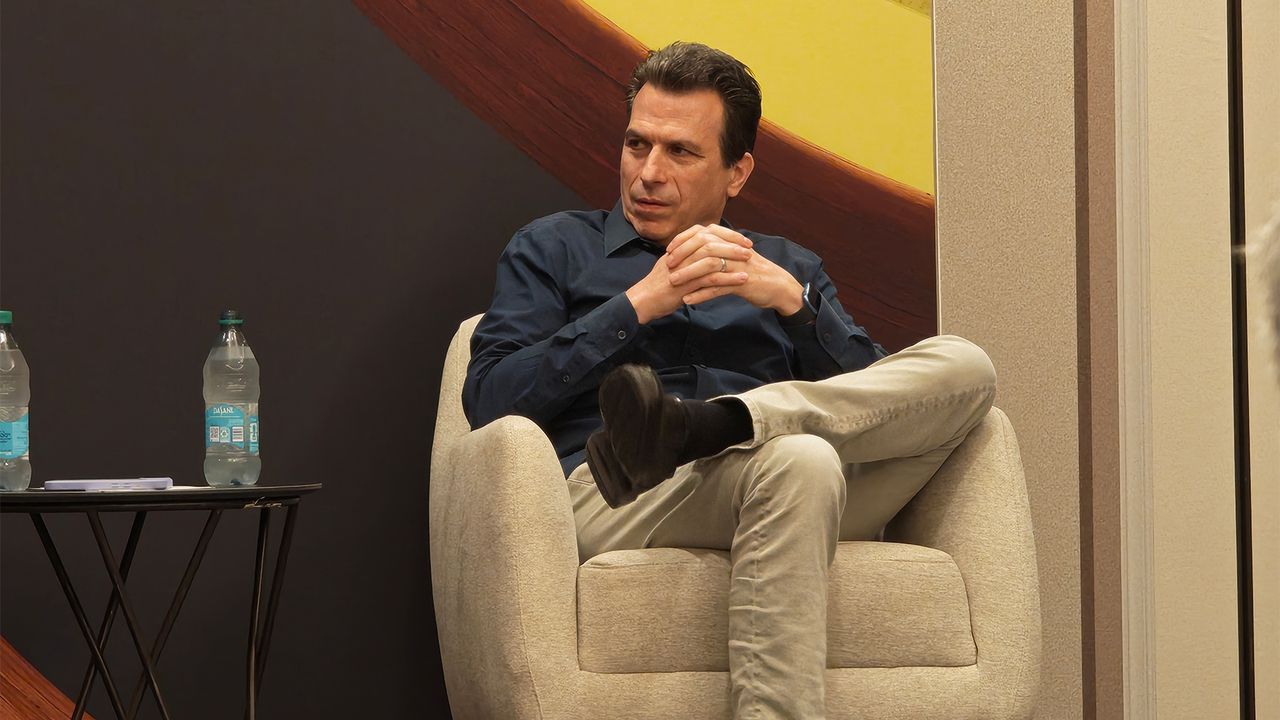
Autodesk CEO Andrew Anagnost talks about the implications of AI at AU26. (Image credit: Future) Copy link Facebook X Whatsapp Pinterest Flipboard Email Share this article 0 Join the conversation Follow us Add us as a preferred source on Google Newsletter Subscribe to our newsletter We’ve gone from…
Autodesk CEO Andrew Anagnost talks about the implications of AI at AU26. (Image credit: Future) Copy link Facebook X Whatsapp Pinterest Flipboard Email Share this article 0 Join the conversation Follow us Add us as a preferred source on Google Newsletter Subscribe to our newsletter We’ve gone from worrying about whether AI will take our jobs to wondering whether it will kill us all within 10 years, which is quite a jump even by the standards of the current AI conversation. This comes after Anthropic Alignment Science Lead Evan Hubinger recently put his personal estimate at more than a 10% chance that AI could kill all humans within the next decade.Speaking at Autodesk University 2026, Autodesk CEO Andrew Anagnost commented on the latest AI doom debate and split the argument into two camps. “There’s a cynical interpretation to this, and then there’s a non-cynical interpretation. I kind of prefer the cynical interpretation,” he says.He explains: “The idea that any of these companies are going to self-regulate themselves at this point is ridiculous. I think some of this is a little bit of political theatre, you know, designed to pump themselves up, ‘look at how great our tech is’ – it’s so good, it’s so dangerous, there’s a 10% chance that we’ll kill everybody.”He isn't arguing that the technology is harmless; quite the opposite, as he states, “There really is a real need to start putting guardrails on this technology. It’s a potentially dangerous technology that can be used in dangerous ways.” Autodesk University 2026 features a lot of new AI tools and features, but they can't kill you. (Image credit: Future)The here and now consequences of AIFor Autodesk, the AI conversation is also becoming much more practical. The company is putting AI into Maya to automate parts of animation and make existing artists more productive, while Flow Studio is taking a broader look at how much of the production process can be connected and automated. MotionMaker, for example, can generate character movement from relatively simple inputs, while Autodesk has been expanding Flow Studio towards AI-assisted characters, assets and production workflows.And there is a consequence to all of that which Anagnost is quite happy to say out loud. “There’s nothing we can do about the fact that these tools are getting more efficient, and because they’re getting more efficient, there are fewer FX artists per film,” he says.That is a much more immediate problem for people working in VFX than whether AI will go full Skynet and wipe out humanity in ten years. If the software gets better at the work, studios don't necessarily need as many people to make the same film. From Anagnost’s point of view, the hope is that studios use that efficiency to make more things rather than simply making the same number of things with fewer people.Get the Creative Bloq NewsletterSign up to Creative Bloq's daily newsletter, which brings you the latest news and inspiration from the worlds of art, design and technology.“The question is, are they going to be making more films with high-quality content? It’s unclear where that goes. It’s a very dynamic space,” he says. “Ideally, what would be happening here is that you’d be making more high-quality content. The artists that are available out there just have fewer hours per piece of content and more content.” Autodesk is releasing AI tools like Flow Studio to speed and aid animation. (Image credit: Autodesk / Flow Studio)That thinking runs through Autodesk’s approach to animation. Maya remains the high-fidelity tool for professional artists, with AI and automation being added to reduce some of the more repetitive work. MotionMaker is one example, and Anagnost says Autodesk will keep adding technologies that take on more grunt work while artists remain in control.Then there is Flow Studio, which Anagnost describes as a "second track", aimed at smaller teams that want to put together an entire production using a collection of increasingly automated tools. “We’re looking at a small team mashing up a bunch of stuff and bringing something together, script to screen in a highly automated way,” he adds.Anagnost sees the eventual destination in film as a kind of script-to-screen system in which artists can assemble and direct much more of a production themselves. “The script-to-screen, the highly art manuscript-to-screen, I think we’re going to move to that world, and Netflix will have to eventually accept that,” he explains. “Because the artist feels like they’re in control; they can run a small team now through this, right? And they can pull technologies to use.”There are obvious implications for the size of creative teams. If a small group can do work that previously required a much larger production, some jobs disappear from individual projects, even if overall content increases. Whether that extra content actually arrives is still an open question. The film and VFX industry is already dealing with changing budgets, streaming economics and a difficult production market, so there is no guarantee that money saved through AI will come back as more work for artists. AI animation in Maya can handle complex models, like horses. (Image credit: Autodesk)Anagnost acknowledges that the industry still hasn't figured out what comes next. “I think we might settle into a place where we’re actually creating more content, lower price, but high-quality content,” he said. “I don’t think we’ve gotten to the knock-on business. Business is still realigning.”For artists, then, the immediate AI question probably isn't whether a machine will end civilisation. It’s whether the next film needs 500 people to make it, or 300, or 50, and what those people end up doing when the software starts handling more of the production.The extinction argument is still there, and Anagnost thinks AI needs real guardrails. But Autodesk is also planning for a future where AI simply makes the production process dramatically more efficient, and that future has consequences for artists long before anyone has to worry about the machines taking over the planet. TOPICS Ian Dean Editor, Digital Arts & 3D Ian Dean is Editor, Digital Arts & 3D at Creative Bloq, and the former editor of many leading magazines. These titles included ImagineFX, 3D World and video game titles Play and Official PlayStation Magazine. Ian launched Xbox magazine X360 and edited PlayStation World. For Creative Bloq, Ian combines his experiences to bring the latest news on digital art, VFX and video games and tech, and in his spare time he doodles in Procreate, ArtRage, and Rebelle while finding time to play Xbox and PS5. View More You must confirm your public display name before commenting Please logout and then login again, you will then be prompted to enter your display name. Logout LATEST ARTICLES 1 Pre-order The Legend of Zelda: Ocarina of Time remake: There's only one downside 2 There's no way this Elon Musk movie poster isn't ironic 3 The new US Space Force uniforms look like the Star Wars Empire meets the SS 4 Oof! Turns out AI is as annoying in office chairs as it is everywhere else 5 Embrace the Fashion Week flavour with these colourful kitchen accessoriesSource: Creative Bloq AI Art — Published — Category: Image AI