Good morning!It’s been a whirlwind week. We had our first look inside a major AI company’s leaked IPO prospectus. Our data appeared in the FT’s explainer on tokenomics. We are continuing to push hard on untangling this data and more over at our AI Investment Brief by Exponential View.Subscribe…
Annons
Annons
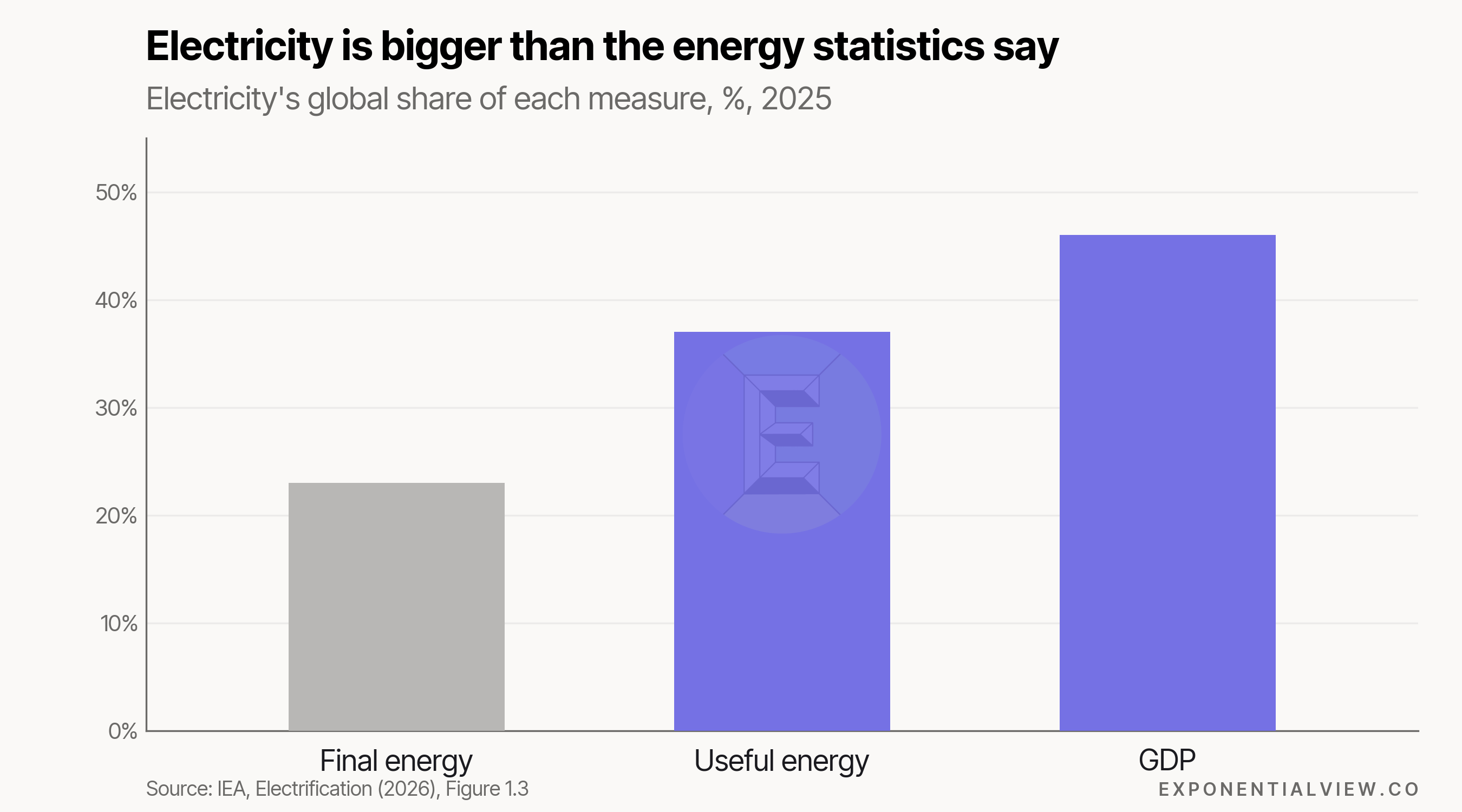
Good morning!It’s been a whirlwind week. We had our first look inside a major AI company’s leaked IPO prospectus. Our data appeared in the FT’s explainer on tokenomics. We are continuing to push hard on untangling this data and more over at our AI Investment Brief by Exponential View.Subscribe nowFurther along than it looksThe electrification of the world economy is further ahead than most people think. Data from the International Energy Agency show that electricity now powers 46% of global GDP. Yet it makes up only 23% of the final energy we use.Which bar you watch determines how far along you think we are. Focus tends to be on final energy because the 77% of final energy that remains unelectrified is where most of the emissions sit. But that understates the progress we have made so far. If we measure electricity by the value it generates, rather than how much we use, the transition looks much further along.The reason for the gap – and much of electricity’s value – is that it’s a more efficient technology. A gasoline car turns about 25% of its fuel into motion. An electric car can do it at 85-90% efficiency (and makes far less noise). It’s the same story across the economy, where a joule of electricity does about 2.5 times as much useful work as a joule of oil.See also: Momentum is still building! In Norway, vans and heavy-duty vehicles are following the move to electric. Once one adjacent technology blazes the trail others can quickly follow.A MESSAGE FROM OUR SPONSORAI ISN’T THE REAL ADVANTAGEAI is everywhere in the enterprise. But Tempo’s latest research shows the advantage is not. To understand why, they spoke to senior leaders already using AI at scale to plan and run complex portfolios. They found that legacy portfolio platforms built for a human workforce are struggling. Yet, only a fraction of teams use AI capabilities end‑to‑end – and they’re already outperforming their peers by a remarkable margin.Tempo’s report shows how to turn AI into your advantage.Download reportCould AI be conscious?Yes, no, maybe. It’s a bit of an unanswerable question, but a new paper from Google DeepMind takes a good crack at mapping the landscape. (Props to EV readers Shamil Chandaria and Anil Seth for co-authoring the work.)The first problem is one you may have hit at 3am on a college couch: no one agrees on what produces consciousness. Some researchers think the right kind of computer could be conscious. Others say it needs a body. Kookier still, some think experience is woven into all matter (rocks included). The second problem is that even people who share a theory can disagree about whether AI shows the right signs.To bring some clarity, the authors fold this debate into a five-level framework that captures many theories about how to assess consciousness:observing a system’s behaviorexamining the algorithms it runsexamining the wiring of its hardwareasking whether it’s a living thing with something at stake (for example, its own life)examining how it’s connected to the worldEach level comes with markers you can test an AI against. Today’s AI does fairly well on the first level, patchily on the second, and abysmally on the last three. You can try it yourself with the paper’s interactive map. Our team’s scores ranged from 0.003 to 0.083 out of 1, so we lean firmly toward no. But those scores depend on the theories we picked. Until there’s better evidence for which theory is right, the honest answer to whether AI is conscious remains: maybe.See also: a great cartoon explaining the paper.Hey Siri, make me $1 millionAs personal agents like Muse, Grok Bot and dots land in our pockets, they’ll start optimizing daily life in lots of small ways. My gym lets me pause my membership for three months a year, and I never do. An agent would pause it every time I went away.Another area where it could help is managing my money. Most people don’t have the time or expertise to move money between bank accounts in search of better rates. But they can: neobanks offer higher yields on deposits than most banks do.Torsten Sløk, chief economist at the asset manager Apollo, asks what happens when every household’s agent starts moving that money. Banks rely on a large pool of cheap, idle deposits to fund their lending. If agents routinely sweep that cash into higher-paying accounts, banks’ funding costs will rise. Sløk calls it an “agentic bank run.”Subscribe nowShort morsels to appear smart at dinner parties🎞️ The best copy of The Good, the Bad and the Ugly owes its existence to amateur pirates who spent years building illegal bootlegs of the movie.🏙️ What’s the best shape for a city? Compact and dense. The interactive model is fun to play with.💘 The Singapore government is running its own dating service using the Gale-Shapley algorithm, which, in theory, leaves no two people who would both rather be with each other than with their matches. Romance, optimized.🤖 OpenAI has released dots, its competitor to Grok Bot. Meanwhile, SpaceXAI owns dot.com, which redirects to the Grok Bot download page.🌀 Brain waves, long dismissed as background noise produced by neurons, may help coordinate thinking.🖥️ A good read: a brief history of the Bloomberg Terminal, the nervous system of global finance.📰 AI models bury bad news unless told not to.🇪🇺 Google, Apple and Amazon each hold more meetings with EU officials than any single European company.Thanks for reading!caption...