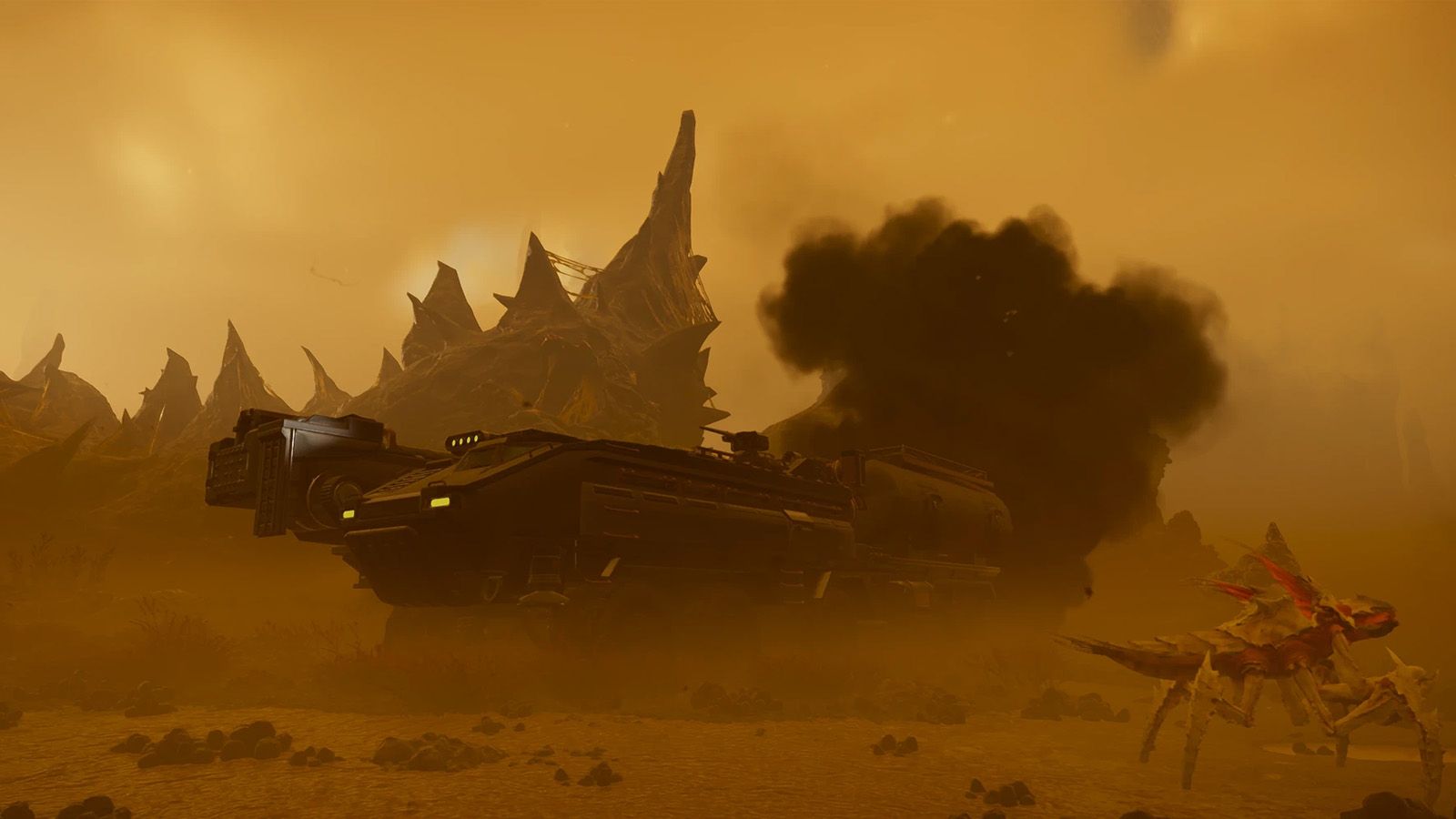
How Helldivers 2 uses Blender to build its gritty sci-fi hardware
(Image credit: Arrowhead Game Studios) Copy link Email Share this article 0 Join the conversation Follow us Add us as a preferred source on Google Newsletter Subscribe to our newsletter With the Scope of Authority Warbond bringing new sniper rifles, ghillie armour, and mine grenades to Helldivers…
Annons
Annons
(Image credit: Arrowhead Game Studios) Copy link Email Share this article 0 Join the conversation Follow us Add us as a preferred source on Google Newsletter Subscribe to our newsletter With the Scope of Authority Warbond bringing new sniper rifles, ghillie armour, and mine grenades to Helldivers 2, we asked Arrowhead concept artist Christian Forsgren how that kind of hardware goes from Blender blockout to an in-game weapon. The answer is speed. “I can see how it actually handles in a player’s hands straight away, not weeks later,” he says. For weapons and machinery, that matters: a badly judged few centimetres can be the difference between convincing military hardware and something from a toy shop.Each asset starts with a brief and a team brainstorm. Forsgren then builds a rough 3D blockout in Blender, refines the functionality, materials and finish, and pushes it into Arrowhead’s Stingray engine to see how it behaves in real time.That loop helps give Helldivers 2 its battered, believable look. Weapons have to be mechanically plausible, and procedural materials add edge wear, grime and volumetric detail “without ever doing a single second of UVs”. Forsgren has also built a Blender pipeline for the game’s Warbond banners, producing renders at a higher fidelity than the game itself can manage, in the series’ propaganda-poster style.There’s plenty here for Blender users beyond games, too: the scripts and add-ons Forsgren uses to speed up his work, the custom tools Arrowhead uses to move assets between Blender and the engine, and why the studio lets artists build their own workflows. The takeaway is that the best pipeline helps artists make better decisions, faster, with fewer hand-offs.For more on Helldivers 2, visit Arrowhead Game Studios. From top left, the process: "First 3D blockout of a two part vehicle… Amended to 6 wheeled vehicle… The final version of the concept model… Added textures and colours in Photoshop… Final in-game screenshot". (Image credit: Arrowhead Game Studios)Creative Bloq: Walk us through a single asset's journey – from concept sketch to final in-game render. Where does Blender's role start and end, and where does the Stingray game engine take over? Christian Forsgren: It starts with a brief, then it’s team brainstorming. After that team brainstorm I take over and focus on ideas we have landed on and take it to a point where we can start to iterate. Say I'm building a weapon: I take the agreed upon brief and build the concept model in Blender, sometimes I do simple sketches depending on the asset to bounce around the team but most of the time it's straight into Blender for easy blockouts to help with scale and animation approximations. When that has reached a reasonable state I take it further and focus on functionality, materials, and how we want the finished asset to look like. When that is greenlit Blender's job ends once the asset's ready to live in the game. We push it straight into Stingray, the game engine, and we're play-testing it in real time so I can see how it actually handles in a player's hands straight away, not weeks later. That's where Stingray takes over: real lighting, real scale, how it sits next to everything else. Then it's a loop with coders, designers, 3D artists and animators until it actually fits the game, not just looks good on its own.